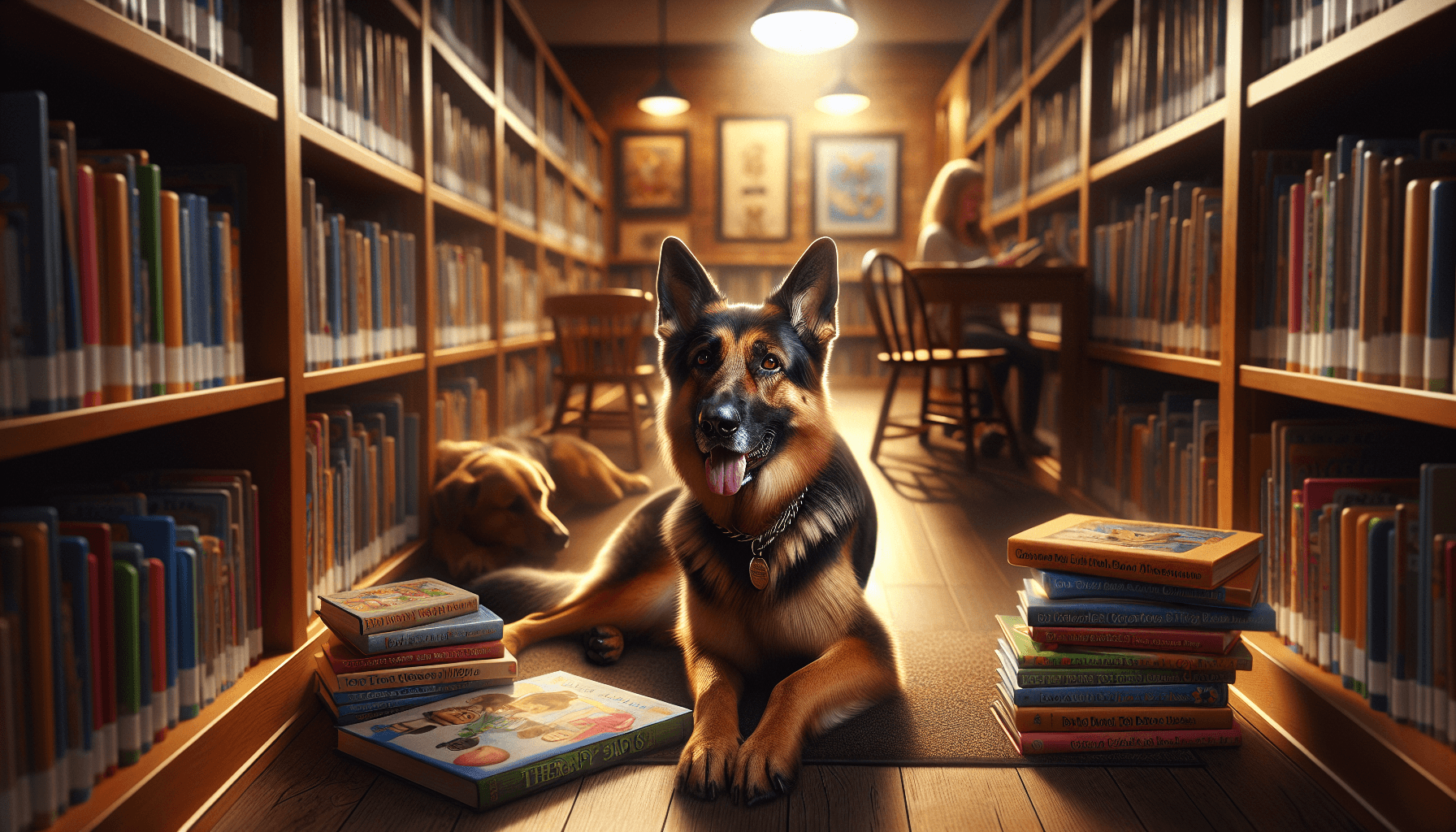
Evaluating Dog Temperament for Therapy Work
Not every good dog is a good therapy dog. Here's how we assess temperament to identify dogs who will truly thrive in the unique demands of reading program work.
# Evaluating Dog Temperament for Therapy Work
The owner was devastated. Her Golden Retriever, Sunny, was the friendliest dog in the neighborhood—beloved by everyone, gentle with children, obedient to a fault. She'd been certain Sunny would sail through therapy dog evaluation and become a wonderful reading companion. Instead, after twenty minutes of assessment, our evaluator gently explained that Sunny wasn't suited for therapy work. The problem wasn't friendliness or obedience. It was something more fundamental: Sunny couldn't tolerate being ignored.
During the evaluation, when the evaluator briefly turned attention away from Sunny to speak with the owner, Sunny nudged persistently for attention, whined softly, and eventually tried to climb into the evaluator's lap. This behavior—charming at home—would be catastrophic in therapy contexts. A reading dog who demands attention undermines the entire purpose of the intervention. The child is supposed to be the focus; the dog is supposed to provide calm, undemanding presence.
Sunny was a wonderful pet, but she would have been a terrible therapy dog. This distinction—between dogs who make excellent companions and dogs who make excellent therapy animals—lies at the heart of temperament evaluation. Not every good dog is a good therapy dog, and identifying the difference early prevents struggling dogs, stressed handlers, and failed sessions.
Understanding What Therapy Work Actually Requires
Before evaluating temperament, we must understand what therapy dog reading work actually demands. The requirements are more specific and more challenging than many people realize.
**Sustained calm in stimulating environments.** Therapy dogs work in libraries, schools, hospitals, and community centers—spaces with unpredictable noise, movement, and activity. A dog who's calm at home but reactive in busy environments will struggle. The calm must be genuine, not suppressed—a dog who holds tension while appearing still is working too hard and will burn out.
Captain, our yellow Labrador, exemplifies genuine calm. During evaluations, we introduce unexpected stimuli—dropped books, sudden movements, strange noises—and watch for recovery time. Captain barely registers these disturbances. His baseline state is so relaxed that disruptions cause momentary attention without tension. This unflappable quality predicts success in actual therapy environments.
**Non-demanding attention patterns.** Therapy dogs must provide presence without demanding reciprocity. Children reading to dogs need to focus on their books, not on satisfying a dog's attention needs. Dogs who nudge, paw, whine, or otherwise solicit attention create exactly the wrong dynamic. The ideal therapy dog offers themselves and then waits, content to be present whether actively engaged or temporarily overlooked.
**Appropriate response to emotional states.** Reading dogs encounter anxious, frustrated, and sometimes distressed children. They must respond to these emotional states without becoming distressed themselves and without inappropriate intensity. A dog who becomes hyperaroused by excitement or shuts down in response to tension can't provide the steady anchoring that struggling readers need.
Luna, our Border Collie mix, demonstrates remarkable emotional attunement. During evaluations, we test how dogs respond to acted emotional states—a person crying, a person frustrated, a child having a meltdown. Luna notices these states, orients toward them, and approaches with appropriate gentleness. She doesn't amplify the emotion or withdraw from it. This balanced responsiveness predicts her effectiveness with emotionally volatile children.
**Physical tolerance for handling.** Children, especially young ones, don't always pet gently or respect body space. Therapy dogs must tolerate—and ideally enjoy—varied types of physical contact from multiple unfamiliar people. Dogs who stiffen at unexpected touch, who prefer petting only from certain angles, or who require warm-up time before accepting handling aren't suited for contexts where children may touch them unexpectedly.
**Recovery and resilience.** Unexpected things happen in therapy settings. A child might accidentally step on a paw. A book might fall off a table. A fire alarm might sound. Therapy dogs must recover from startle quickly and return to baseline without lingering stress. Dogs with slow recovery—who remain vigilant or unsettled after minor disruptions—accumulate stress that eventually manifests as burnout or behavioral problems.
The Evaluation Process: What We Actually Assess
Our temperament evaluation uses structured scenarios designed to reveal how dogs respond to therapy-relevant situations. Each scenario tests specific qualities while the overall pattern reveals the dog's fundamental temperament profile.
Initial Observation: Baseline State Assessment
Before any structured testing, we observe the dog simply existing in our evaluation space. How does the dog arrive—excited, anxious, curious, calm? How quickly do they settle? What's their default activity level? Do they explore systematically or frantically? Do they check in with their handler frequently or independently manage their emotional state?
Ginger, our Shiba Inu, demonstrated ideal baseline behavior during her evaluation. Within five minutes of entering an unfamiliar space, she'd explored systematically, accepted the new environment, and settled near her handler without requiring reassurance. This efficient adjustment to novelty predicted her ability to enter diverse therapy settings without lengthy acclimation periods.
The Neutral Stranger Test
A neutral evaluator approaches the dog without excessive friendliness—no baby talk, no excited greeting, just calm approach and brief interaction. We watch for the dog's response: Do they accept approach without excessive excitement or fear? Do they engage appropriately without demanding more? Can they disengage smoothly when the interaction ends?
Dogs who leap toward strangers with overwhelming enthusiasm may seem friendly, but they're actually showing poor impulse control. Dogs who cower or avoid aren't comfortable with the human interaction that therapy work requires. The ideal response is confident, moderate engagement followed by easy release when the interaction concludes.
The Active Crowd Scenario
Multiple people move around the dog with varying energy levels—walking, talking, laughing, occasionally making sudden movements. We assess whether the dog tracks all movement vigilantly (hyperarousal), ignores everything (concerning dissociation), or maintains relaxed awareness (appropriate). We watch for tension accumulation—does the dog become progressively more stressed as time passes, or do they find their equilibrium and stay there?
Koda, our Bernese Mountain Dog, shone during this test. His large size means crowded environments could easily feel threatening, but Koda demonstrated remarkable equanimity. He noticed movement without tracking it obsessively, maintained soft body language throughout, and actually seemed to relax as the scenario continued—evidence that busy environments don't deplete his resources.
The Distracting Sounds Test
We introduce therapy-environment sounds: children's voices at various volumes, sudden noises (books dropping, doors slamming), and ambient noise that therapy settings typically contain. We watch startle responses, recovery time, and whether dogs habituate or sensitize with repeated exposures.
Olive, our Basset Hound, barely twitched at any sound during her evaluation. Her evaluator noted that her baseline was so relaxed that startle responses essentially didn't register. This sound tolerance makes her invaluable in library settings where noise is inevitable.
The Emotional Response Scenario
An actor demonstrates various emotional states while the dog observes: happiness, sadness, frustration, anxiety. We assess whether dogs notice emotional shifts, how they respond, and whether they maintain appropriate boundaries. Some dogs approach distressed humans too intensely; others avoid them entirely. Neither extreme is ideal.
Pepper, our Dalmatian, demonstrated exceptional emotional intelligence during this scenario. He noticed sadness and approached with gentle curiosity, but didn't overwhelm the "upset" person. He recognized anxiety and offered calm presence without becoming anxious himself. His responses suggested genuine empathy rather than just behavioral training.
The Handling Tolerance Assessment
Multiple unfamiliar people handle the dog in various ways: firm petting, gentle touches, slightly awkward handling that mimics children's less-coordinated movements. We watch for tension, avoidance, or excessive arousal. Therapy dogs must enjoy—not just tolerate—being touched by strangers.
Honey, our Goldendoodle, practically melts into anyone who touches her. Her handling tolerance is extraordinary—she remains soft and relaxed regardless of who's petting her or how. This genuine enjoyment of human contact translates to the authentically welcoming presence that makes her effective with cautious children.
The Recovery and Resilience Test
We deliberately startle the dog—drop an object nearby, clap suddenly, create an unexpected noise—and then measure how long they take to return to baseline. Quick recovery indicates resilience; prolonged vigilance or avoidance indicates stress that would accumulate during actual therapy work.
Charlie, our Beagle, demonstrated ideal recovery patterns. When startled, he'd orient toward the sound, assess it as non-threatening within seconds, and return to his previous relaxed state. This pattern—notice, assess, release—predicts his ability to handle the unpredictability of reading sessions without accumulating stress.
What Disqualifies Dogs from Therapy Work
While we focus on identifying suitable dogs, it's equally important to recognize disqualifying factors. Some temperament patterns simply preclude successful therapy work regardless of training.
**Fear-based reactivity.** Dogs who respond to unexpected stimuli with fear—barking, lunging, hiding, freezing—cannot safely work in unpredictable therapy environments. Fear may manifest as aggression, which creates obvious safety concerns, but even pure avoidance behaviors interfere with the steady presence therapy work requires.
**Resource guarding.** Any tendency to guard food, toys, space, or people disqualifies dogs from therapy work. Children are unpredictable around resources; a dog who might guard creates unacceptable risk.
**Excessive arousal.** Dogs who become extremely excited by human attention, regardless of how friendly that excitement is, cannot provide the calm environment struggling readers need. High arousal interferes with the relaxation that makes therapy dogs effective.
**Poor recovery.** Dogs who startle easily and recover slowly will accumulate stress that manifests as behavioral deterioration over time. Even if they perform adequately initially, they'll burn out.
**Handler dependence.** Dogs who cannot function confidently away from their handler, who constantly check for reassurance, or who become distressed when handlers are occupied won't succeed in therapy contexts where handler attention may be divided.
**Physical sensitivity.** Dogs who are sensitive about being touched in certain ways, who prefer controlling how and when contact happens, or who require trust-building before accepting handling aren't suitable for contexts where strangers will touch them unpredictably.
Breeds and Individual Variation
Questions about breed suitability arise frequently. While certain breeds are statistically more likely to succeed in therapy work, individual variation within breeds is enormous. Our team includes dogs from diverse breeds precisely because temperament is individual, not breed-determined.
Apollo, our Great Dane, confounds expectations for his breed. Great Danes can be reserved or sensitive, but Apollo's specific temperament—confident, calm, genuinely social—makes him an exceptional therapy dog. His breed provided his impressive size; his individual nature provided his impressive suitability.
Similarly, Ginger, our Shiba Inu, belongs to a breed often described as aloof or independent. Yet Ginger's particular temperament includes genuine warmth toward humans and unusual calm for her breed. Her success proves that breed generalizations, while statistically useful, don't determine individual outcomes.
We evaluate every candidate as an individual, using breed information as context rather than criterion. A Golden Retriever with poor stress tolerance is less suitable than a mixed breed with excellent recovery, regardless of breed stereotypes about "natural therapy dogs."
The Difference Between Temperament and Training
A crucial distinction in therapy dog evaluation is between what can be trained and what cannot. Certain behaviors are trainable; fundamental temperament is not.
**Training can address:** obedience commands, specific behaviors on cue, habituation to particular stimuli, and refinement of existing positive tendencies. A dog with appropriate temperament who lacks training can be developed; a dog with inappropriate temperament who has excellent training cannot.
**Temperament determines:** baseline arousal levels, recovery speed after stress, fundamental social orientation, emotional sensitivity and resilience, and core responses to novelty and challenge. These characteristics are established early in development and remain relatively stable throughout life.
Biscuit, our founding Golden Retriever, arrived with minimal formal training but exquisite temperament. Her natural calm, genuine social interest, and remarkable resilience were evident from her first evaluation. Training refined these qualities into polished therapy dog behavior, but the foundation was innate.
Tucker, our Australian Shepherd, came to us already well-trained in obedience. But his evaluation revealed temperament even more valuable than his training: profound patience, intuitive understanding of human emotional states, and stability that no training program could have created. His training gave him tools; his temperament gave him capability.
Evaluation as Prediction, Not Judgment
Temperament evaluation isn't about labeling dogs as "good" or "bad." It's about predicting whether a specific dog will thrive in a specific role. A dog who fails therapy evaluation might excel as a search and rescue dog, an agility competitor, or simply a beloved family pet. The evaluation reveals fit, not worth.
Sunny, the Golden Retriever whose story opened this guide, went on to become an excellent dog—just not a therapy dog. Her intense social needs, which made therapy work inappropriate, made her perfect for a family with children who wanted a dog who'd be constantly engaged with them. Her needs weren't wrong; they were simply mismatched with therapy work's demands.
We try to communicate this distinction clearly to owners whose dogs don't pass evaluation. The goal isn't crushing hopes—it's directing dogs toward roles where they'll actually thrive. A dog forced into inappropriate work suffers, regardless of how well-intentioned the forcing.
Post-Evaluation: What Comes Next
Dogs who pass initial temperament evaluation proceed to more extensive assessment and training. Passing evaluation doesn't guarantee therapy work success—it indicates foundational suitability that can be developed.
The training period that follows evaluation further refines our understanding of each dog's capabilities and limitations. Some dogs who pass evaluation ultimately don't complete training; others exceed our initial assessments. Max, our German Shepherd, seemed merely adequate during evaluation but bloomed during training into one of our most capable dogs. His initial reserve was actually deep assessment; once he understood the context, he excelled.
Dogs who don't pass evaluation receive feedback about what was observed and why therapy work isn't recommended. Sometimes specific issues are addressable—a young dog with excessive arousal might be reevaluated after maturity; a dog with one concerning response might be tested in different contexts. But fundamental temperament mismatches aren't fixable, and we're honest about that.
Trusting the Process
Temperament evaluation feels subjective because it involves qualitative observation rather than quantitative measurement. But evaluators develop genuine expertise through experience. Evaluators who've assessed hundreds of dogs learn to recognize patterns that predict success or failure—subtle indicators that novices might miss.
Every dog in the Paws & Pages program passed comprehensive temperament evaluation. Every one showed the calm baseline, appropriate social orientation, emotional resilience, and physical tolerance that therapy work demands. This is why our dogs succeed—not because we're lucky, but because we select carefully.
The families who brought dogs expecting easy passage and received disappointing news may have felt frustrated in the moment. But they were protected from watching their dogs struggle in inappropriate roles. The children who read to our dogs are protected by knowing that every dog they encounter has been evaluated for exactly the qualities that make reading sessions safe and effective.
Evaluation is where quality begins. Everything else builds on the foundation of genuine temperament suitability that careful evaluation identifies.

Paws & Pages Team
The Paws & Pages team is dedicated to building confident readers through the unconditional love of therapy dogs. Our team of educators, trainers, and volunteers share tips, stories, and resources to support literacy and the human-animal bond.
View all posts