How Dogs Help With Reading Comprehension
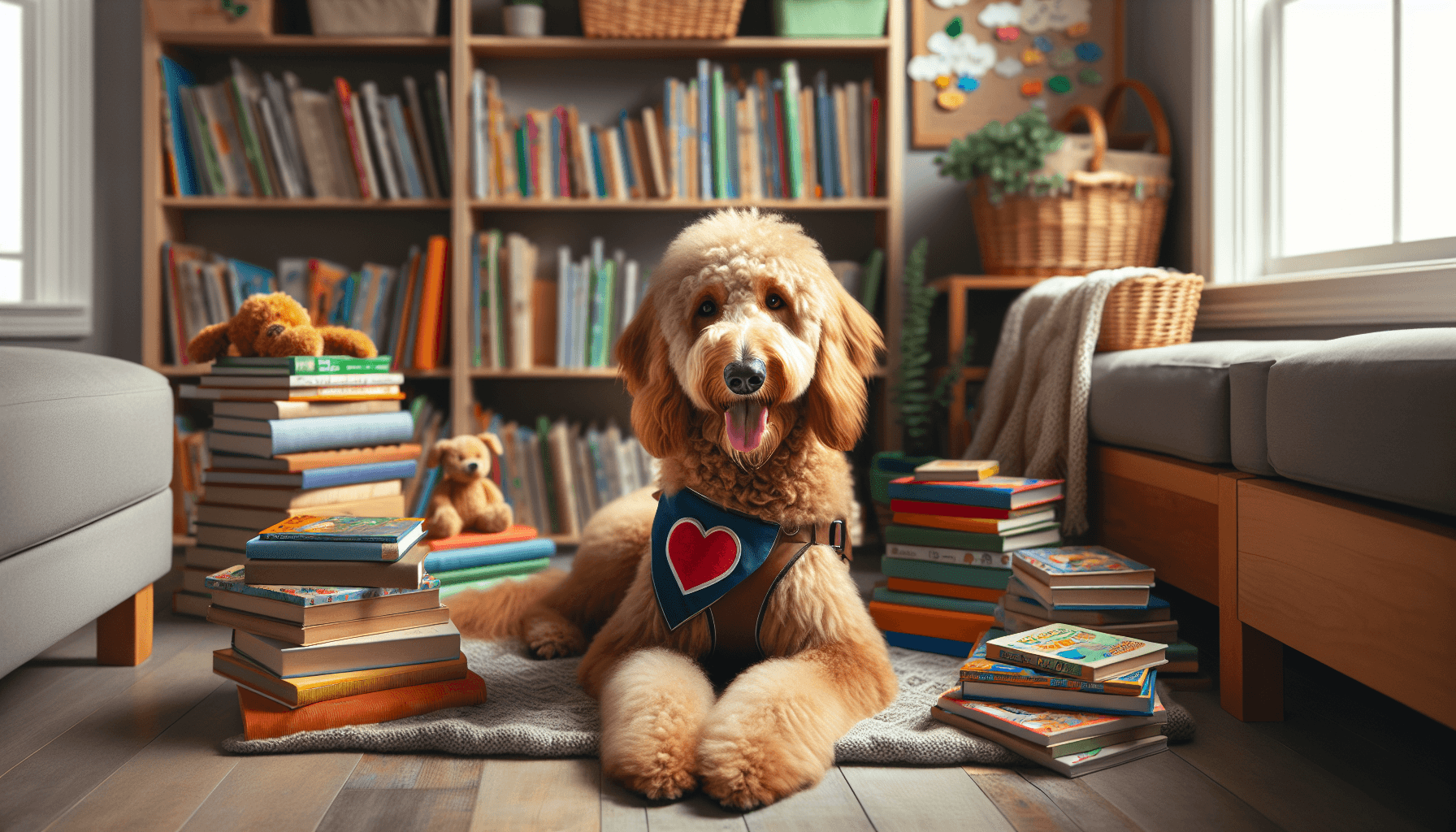
Beyond just fluency, therapy dogs help children understand, remember, and connect with what they read. Here's how the magic works.
# How Dogs Help With Reading Comprehension
Reading fluency—the ability to read smoothly and accurately—often gets the spotlight in discussions about therapy dog reading programs. But fluency is only half the equation. True reading success requires comprehension: understanding what the words mean, connecting ideas across paragraphs, inferring character motivations, and remembering plot details long after the book closes. At Paws & Pages, we've discovered that our therapy dogs help with comprehension in ways that surprised even us.
When Captain, our enthusiastic yellow Labrador, perks up his ears during an exciting scene, children don't just read faster—they read more attentively. When Biscuit tilts her golden head at a confusing passage, readers instinctively pause to explain. These interactions transform reading from a solitary decoding exercise into an interactive storytelling experience, and that shift makes all the difference for comprehension.
The Explanation Effect: Teaching Improves Understanding
Educational researchers have long known that explaining something to someone else deepens your own understanding. This phenomenon, sometimes called "the protégé effect," works because explaining requires you to organize your thoughts, identify gaps in your knowledge, and connect concepts in coherent ways. Therapy dogs create natural opportunities for this kind of explanatory learning.
Eight-year-old Daniel discovered this with Jasper, our dignified silver Standard Poodle. Daniel, on the autism spectrum, found unpredictability distressing, but Jasper's consistent, statue-like calm provided the stability he needed. As Daniel grew comfortable, he began reading non-fiction to Jasper—facts about dinosaurs, planets, and volcanoes. But Daniel didn't just read; he explained. "Jasper, this is important," he would say, pointing at a diagram. "See, the T-Rex had tiny arms but huge teeth. That's why he couldn't clap but he could bite really hard."
Daniel's teacher noticed something remarkable: his retention of information from books read to Jasper far exceeded his retention from classroom reading. The act of explaining to an attentive, non-judgmental audience—even one who couldn't actually understand the words—forced Daniel to process and organize information rather than simply decoding text.
Slowing Down: How Patience Improves Understanding
Many struggling readers rush through text, focused on finishing rather than understanding. They've learned that reading is a test to survive rather than an experience to enjoy. This rushing is comprehension's enemy—studies show that faster reading correlates with lower retention and understanding, particularly for challenging material.
Olive, our Basset Hound, has become our secret weapon against rushing. It's impossible to hurry when you're reading to a dog who ambles through life like she has nowhere else to be. Her long, droopy ears and soulful eyes project an air of infinite patience that gives permission to slow down. "Olive speed," as one reader named it, has become a celebrated approach in our program.
Ten-year-old Mira had spent years being told to "keep up" and "hurry along." Her comprehension suffered because she was so focused on pace that she couldn't attend to meaning. Reading to Olive changed everything. There was no one to keep up with, no competition, no clock. Mira began pausing at the end of paragraphs, looking at Olive's peaceful face, and thinking about what she'd just read. Her comprehension scores improved dramatically, but more importantly, she began actually enjoying books—something she'd never experienced before.
Emotional Engagement: The Gateway to Memory
We remember what moves us. Emotional engagement isn't just nice to have; it's neurologically essential for memory formation. The amygdala, the brain's emotional processing center, directly influences the hippocampus, where memories are consolidated. When reading triggers emotional responses, comprehension and retention improve.
Captain has turned this science into an art form. Our yellow Lab can't hide his emotions during exciting stories—his ears perk up during chase scenes, his tail thumps during happy moments, and he sometimes barks during climaxes. Children read with more expression and engagement because they're performing for an audience who visibly reacts.
Twins Sophia and Maya, age eight, had a breakthrough with Captain during a pirate adventure story. When Sophia read about the hero escaping a storm, Captain's tail went wild. When Maya read about finding treasure, he sat up alertly and barked once in celebration. "He likes both of us!" Maya exclaimed. But more than feeling validated, the twins were emotionally invested in the story in ways they'd never experienced before. Weeks later, they could recount plot details and character names with striking accuracy—because the emotional experience had burned the story into memory.
Making Predictions: Active Reading With Canine Companions
Good comprehension requires active reading—making predictions, asking questions, connecting new information to existing knowledge. Passive reading, where words wash over the reader without engagement, produces fluency without understanding. Therapy dogs encourage active reading through their natural interactivity.
Luna, our Border Collie mix with heterochromatic eyes, has an intense, questioning gaze that prompts children to think out loud. "Luna, I bet the princess is going to trick the dragon," nine-year-old James found himself saying mid-chapter. This prediction-making—stimulated by Luna's attentive presence—is exactly what reading researchers recommend. Making predictions forces readers to synthesize information, consider character motivations, and engage with narrative structure.
Handler Marcus Thompson noticed that children reading to Luna naturally paused to make comments, predictions, and connections. They'd say things like, "Oh Luna, this is just like that other book!" or "I think she's going to make a mistake here." These verbal check-ins transformed reading from passive consumption to active construction of meaning.
The Re-Reading Revolution: When Repetition Becomes Pleasure
Comprehension deepens with re-reading. Each pass through a text reveals new details, connections, and meanings. But struggling readers typically resist re-reading—why would they voluntarily repeat an unpleasant experience? Therapy dogs change this equation by making reading enjoyable enough to repeat.
Bella, our Cavalier King Charles Spaniel, has inspired more re-reading than any intervention we've tried. Her small size makes her perfect for lap-sitting, and children who finish a book in her presence often immediately say, "Can I read it again? I want to show Bella the good parts!" That impulse—to revisit favorite moments—is exactly the kind of engaged re-reading that builds comprehension.
Five-year-old Oliver exemplified this pattern. After learning to read basic words with Bella's patient presence, he asked to read "Go, Dog. Go!" to her. He read it once. Then twice. Then three times in a row. Each reading, he noticed something new—a detail in an illustration, a joke in the text, a pattern in the language. His mother reported the same book went home with them and was read to their cat "at least twenty more times." This enthusiastic repetition, motivated by the joy of the original reading experience, built comprehension skills that no worksheet could match.
Visual Literacy: Picture Books and Dog Reactions
Comprehension isn't limited to text—understanding illustrations and visual narratives is increasingly important in our image-rich world. Picture books combine text and image in ways that require readers to integrate information from multiple sources. Therapy dogs enhance this visual comprehension by providing an audience for illustration exploration.
When Thomas Park reads picture books with young children and Bella, he encourages them to "show Bella the pictures." This simple prompt triggers rich descriptive language and visual analysis. Children point out details, explain what's happening, and connect images to text. "See Bella? The boy looks scared, but look—his dog is right there with him. So he's going to be okay." These observations demonstrate sophisticated comprehension of visual narrative.
Daisy, our smiling Samoyed, is particularly effective with children learning English as a second language. Visual literacy transcends language barriers, and describing pictures to Daisy helps bridge the gap between images and English words. Eight-year-old Yuki would point to illustrations and say both the Japanese and English words, with Daisy's encouraging expression validating both languages. This multimodal approach—combining visual, verbal, and emotional engagement—accelerated Yuki's reading comprehension in her new language.
Narrative Retelling: Dogs as Story Audience
The ability to retell a story in your own words is a gold-standard measure of comprehension. It requires understanding plot sequence, identifying important events, recognizing character development, and organizing information coherently. Many children struggle with retelling because it feels like a test. But telling a story to a dog? That's just sharing.
At the end of each session, handlers in our program encourage children to "tell [dog name] what happened in the story today." This simple practice has become one of our most effective comprehension strategies. Children who stumble through formal retelling in classrooms become animated storytellers when their audience is a furry friend.
Koda, our Bernese Mountain Dog, seems to inspire particularly elaborate retellings. His warm, patient expression encourages children to take their time, adding details and explanations. "Okay Koda, so there was this girl, and she was really sad because..." Nine-year-old Emma would begin, and fifteen minutes later, she'd still be explaining character motivations and plot twists to Koda's attentive face. Her teacher, receiving reports of these sessions, was astonished at the sophistication of Emma's story analysis.
Building a Comprehension Culture
The comprehension benefits of therapy dog reading extend beyond individual sessions. Children who develop strong reading comprehension through our program carry those skills into classrooms, homework, and independent reading. The strategies they discover—slowing down, explaining, predicting, engaging emotionally—become habits that serve them throughout their education.
Charlie, our Beagle with his bookstore background, has been part of countless comprehension breakthroughs. His relaxed, happy-go-lucky demeanor creates an atmosphere where deep reading feels natural. Twin brothers Ethan and Noah, who initially had opposite reading problems—Ethan rushing without comprehension, Noah plodding without confidence—found balance through Charlie. They learned to read at "Charlie pace": engaged enough to keep his attention, thoughtful enough to actually understand.
Reading comprehension isn't just an academic skill—it's the foundation for lifelong learning, critical thinking, and informed citizenship. When children learn to understand what they read, they gain access to worlds of knowledge and experience. And as our eighteen therapy dogs demonstrate every day, sometimes the best reading teachers have four legs, wet noses, and an infinite capacity for patient attention.
Paws & Pages Team
The Paws & Pages team is dedicated to building confident readers through the unconditional love of therapy dogs. Our team of educators, trainers, and volunteers share tips, stories, and resources to support literacy and the human-animal bond.
View all posts