
The Science of Animal-Assisted Learning
Discover the fascinating neuroscience behind why reading to dogs works: from cortisol reduction to oxytocin release, the research validates what our young readers already know.
# The Science of Animal-Assisted Learning
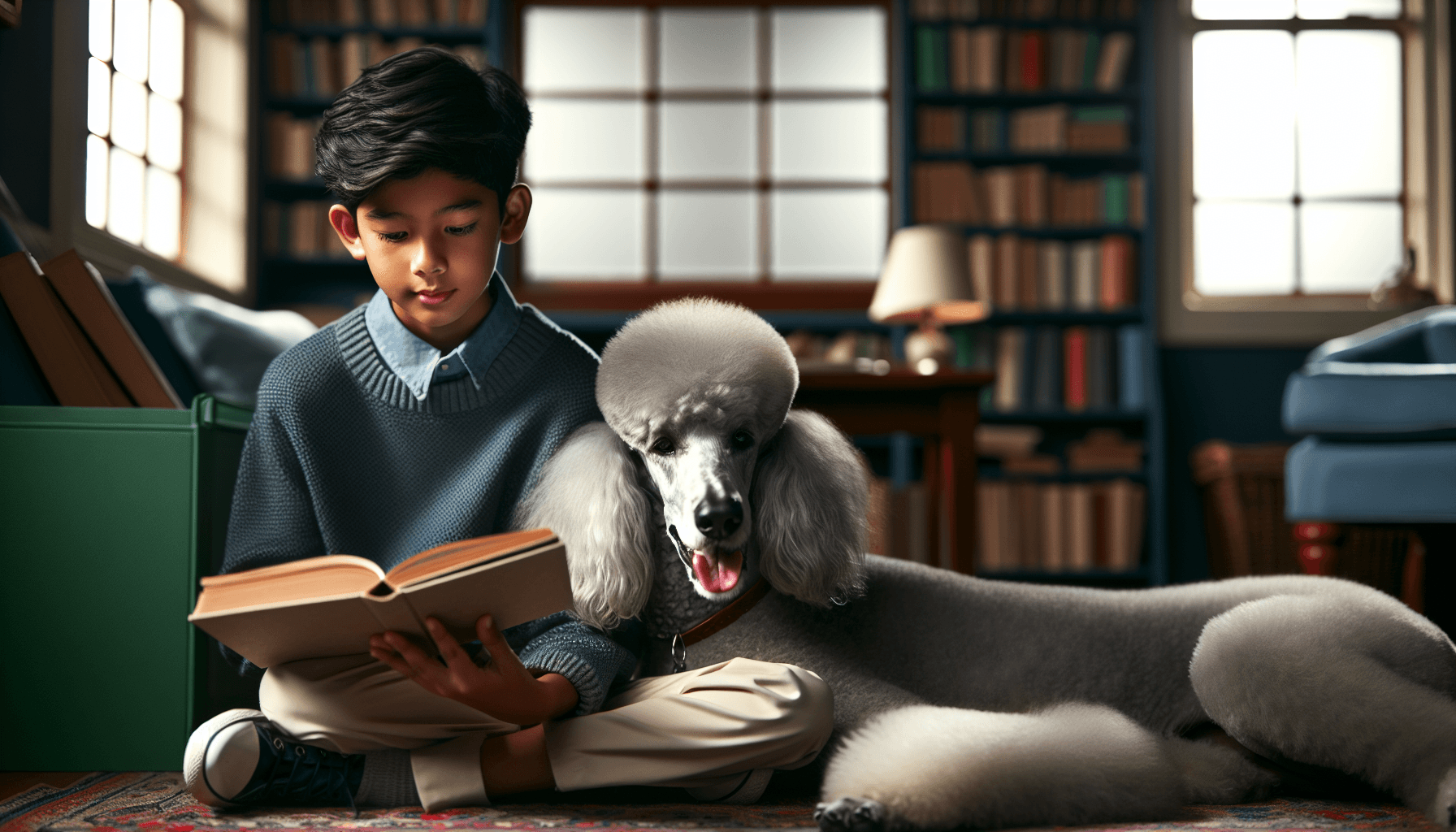
When seven-year-old Marcus reads to Biscuit, our founding Golden Retriever, something remarkable happens in his brain. His shoulders drop, his breathing slows, and words that moments ago seemed like insurmountable obstacles begin flowing more easily from his lips. Marcus doesn't know about cortisol levels or oxytocin release—he just knows that reading feels different when Biscuit's warm head rests on his foot. But behind that simple observation lies a growing body of scientific research that explains precisely why therapy dogs make such effective learning partners.
At Paws & Pages, we've witnessed thousands of these transformations. Yet until recently, the scientific community treated animal-assisted interventions with skepticism, dismissing the benefits as merely anecdotal or placebo effects. Today, advances in neuroscience and rigorous clinical studies have changed that narrative entirely, revealing that the magic children experience with therapy dogs is grounded in measurable biological and psychological mechanisms.
The Stress Response: How Dogs Calm the Learning Brain
Learning requires a brain state that psychologists call "relaxed alertness"—engaged enough to process new information but calm enough to avoid the cognitive shutdown that stress triggers. Unfortunately, for many struggling readers, the mere sight of a book activates their stress response, flooding their systems with cortisol and adrenaline. This "fight or flight" reaction literally impairs the brain regions responsible for language processing and memory formation.
Research from multiple universities has documented that interacting with dogs significantly reduces cortisol levels. A landmark study from Washington State University found that just ten minutes of petting a dog lowered cortisol by an average of 21%. For children with reading anxiety, this biochemical shift is transformative. When eight-year-old Yuki first sat down with Daisy, our perpetually smiling Samoyed, her hands trembled as she opened her book. But after a few minutes of petting Daisy's cloud-like fur, the trembling stopped. "Daisy smile no matter what," Yuki observed. "She think all reading is good reading." That observation captures something profound: in Daisy's non-judgmental presence, Yuki's stress response simply couldn't maintain its grip.
The autonomic nervous system tells a similar story. Multiple studies demonstrate that reading to dogs lowers blood pressure and slows heart rate—physiological markers of parasympathetic activation, the "rest and digest" state that supports learning. Luna, our Border Collie mix with her distinctive mismatched eyes, seems to intuitively understand this science. She positions herself closer to readers precisely when their stress levels rise, as if she can sense the cortisol spike before it fully manifests.
Oxytocin: The Bonding Hormone That Builds Confidence
If cortisol is the enemy of learning, oxytocin is its ally. Often called the "love hormone" or "bonding hormone," oxytocin creates feelings of trust, connection, and safety—exactly the emotional foundation struggling readers need. Research published in the journal Frontiers in Psychology demonstrated that mutual gaze between humans and dogs triggers oxytocin release in both species, a feedback loop that strengthens with each interaction.
This explains why the relationship between therapy dog and reader often deepens over time. James, a nine-year-old with a severe stutter, barely spoke during his first sessions with Luna. But as their bond developed, something shifted. Luna would rest her head on his knee at moments when his stutter seemed about to overwhelm him, and that simple touch was enough to calm his nervous system. His speech therapist later called it "the breakthrough we'd been waiting years for." The oxytocin-mediated bond between James and Luna created a safe space where the risk of judgment simply didn't exist.
Koda, our gentle Bernese Mountain Dog, demonstrates the oxytocin effect powerfully with children processing grief or trauma. When nine-year-old Emma lost her grandfather—her former reading buddy—books became sources of pain rather than pleasure. She didn't read to Koda at first; she just cried into his thick, warm fur. But that physical contact, that sustained oxytocin release, slowly rebuilt her capacity for connection. Eventually, she brought her grandfather's favorite book, "The Velveteen Rabbit," and read it to Koda while tears streamed down her face. The oxytocin didn't erase her grief, but it created a neurochemical environment where healing could begin.
Attention and Focus: The Canine Advantage
Children with attention challenges face particular struggles with reading. The sustained focus required to decode text, comprehend meaning, and track narrative threads can feel impossible when every stimulus competes for attention. Interestingly, research suggests that dogs may help regulate attention in ways that traditional interventions cannot.
Tucker, our blue merle Australian Shepherd, has become our specialist for easily distracted readers. His heterochromatic eyes—one blue, one amber—naturally draw and hold attention. Handler Sandra Lee trained Tucker using mindfulness principles, teaching him to maintain calm, centered focus even in busy environments. For ten-year-old Jordan, diagnosed with ADHD, Tucker's steady gaze became an anchor. "He's like my brain's reset button," Jordan explained. The process Jordan developed—read a sentence, look at Tucker's eyes, read another sentence—leveraged Tucker's natural attentional magnetism to build reading stamina.
A 2019 study in the Journal of Veterinary Behavior found that children reading to dogs showed significantly fewer "off-task behaviors" compared to reading alone or to human listeners. The researchers hypothesized that dogs provide a unique combination of engagement and non-demand—they're interesting enough to maintain attention but don't create the performance pressure that human audiences inadvertently introduce.
The Non-Judgmental Listener: Psychological Safety in Learning
Perhaps the most powerful mechanism behind animal-assisted learning isn't biological at all—it's psychological. Dogs don't correct pronunciation. They don't sigh when a reader stumbles over a word for the fifth time. They don't compare one child's progress to another's. This complete absence of judgment creates what educational psychologists call "psychological safety," a prerequisite for the risk-taking that learning requires.
Consider Olive, our Basset Hound with her impossibly long ears and soulful eyes. Olive moves through life at her own leisurely pace—the very embodiment of patience. For children with auditory processing challenges who read more slowly than their peers, Olive provides something invaluable: permission. Eight-year-old Mira, who had spent years being told to "try to keep up," found in Olive a listener who never rushed. "Olive speed," Mira called it proudly, transforming her pace from shameful to celebrated.
Ginger, our dignified Shiba Inu, offers a different kind of psychological safety—one built on respectful distance rather than enthusiastic affection. For eleven-year-old Alex, who experienced selective mutism and found most therapy animals overwhelming, Ginger's calm indifference was paradoxically liberating. Ginger didn't demand interaction. She simply existed nearby, offering companionship without pressure. Within weeks, Alex was reading complete pages aloud—something years of conventional therapy hadn't achieved.
Neuroplasticity and Positive Association
The brain's capacity to rewire itself—neuroplasticity—means that experiences shape neural pathways. When reading consistently pairs with stress and shame, the brain builds associations that make books feel threatening. But when reading pairs with the warmth, comfort, and oxytocin-rich experience of canine companionship, new neural pathways form.
Rosie, our buff Cocker Spaniel with her perpetually wagging tail, exemplifies this rewiring process. Seven-year-old Maya had developed such severe reading anxiety that she cried daily at school. Her first session with Rosie, Maya entered with red eyes and slumped shoulders. But Rosie's irrepressible joy was contagious—within minutes, Maya was giggling while reading "Dog Man" comics. Six weeks later, Maya asked to read at home. "I want to practice so I have more stories for Rosie," she explained. The neural pathway had shifted: reading now associated with joy rather than dread.
Research from the University of California, Davis, documented this rewiring quantitatively. Children participating in therapy dog reading programs showed 12-17% improvement in reading fluency over just ten weeks. More importantly, follow-up studies found that gains persisted and even continued growing after the program ended, suggesting genuine neuroplastic change rather than temporary effects.
The Social-Emotional Dimension
Reading isn't purely cognitive—it's deeply social and emotional. Stories help children understand perspectives, navigate relationships, and process difficult emotions. Therapy dogs enhance this social-emotional learning by modeling qualities that struggling readers need to internalize: patience, non-judgment, unconditional positive regard.
Max, our German Shepherd who was "career-changed" from police work, teaches children that being labeled "not right" for one path doesn't define your worth. Eleven-year-old Jason, struggling with dyslexia, deeply related to Max's story. "We're both career-changers," Jason told his handler. "We just gotta find where we fit." That reframe—from failure to different path—emerged not from direct instruction but from the living example of a dog who found his purpose.
Pepper, our Dalmatian with his distinctive spots and rescue background, demonstrates resilience. His journey from abandoned and underweight to healthy and helpful resonates with children facing their own challenges. For Tyler, whose family had experienced homelessness, Pepper's story provided hope: "Maybe if Pepper can be okay, I can be okay too."
Implementing Evidence-Based Practice
Understanding the science behind animal-assisted learning allows us to optimize our programs. We schedule sessions for optimal length (30-45 minutes) based on research about attention spans and cortisol rhythms. We train handlers to recognize stress signals in both dogs and children, intervening before negative associations form. We match dogs to readers based on temperament compatibility, understanding that Bella's lap-sized comfort serves different needs than Apollo's imposing gentleness.
The research also guides what we don't do. We never force interactions, understanding that psychological safety requires genuine choice. We don't use treats or rewards during reading sessions, recognizing that the focus should remain on the reading-dog bond rather than external reinforcement. We limit the number of children each dog sees per day, protecting the dogs' welfare while ensuring each reader gets a calm, fully present companion.
A Partnership of Science and Heart
The science of animal-assisted learning validates what our young readers have always known: something magical happens when you read to a dog. That magic has names now—cortisol reduction, oxytocin release, psychological safety, neuroplasticity—but the names don't diminish the wonder. If anything, understanding the mechanisms deepens our appreciation for the remarkable partnership between children and canines.
Biscuit, lying peacefully at Marcus's feet while he reads, doesn't know she's a scientific instrument of healing. She doesn't know about the neurochemical cascades she triggers or the neural pathways she helps reshape. She just knows that Marcus is here, that he's reading, and that her job is to listen. The science says that's exactly enough.
Paws & Pages Team
The Paws & Pages team is dedicated to building confident readers through the unconditional love of therapy dogs. Our team of educators, trainers, and volunteers share tips, stories, and resources to support literacy and the human-animal bond.
View all posts